Amazing interior of police station that hasn’t been disturbed since 90s and is now to be sold
Thursday, 30th May 2013
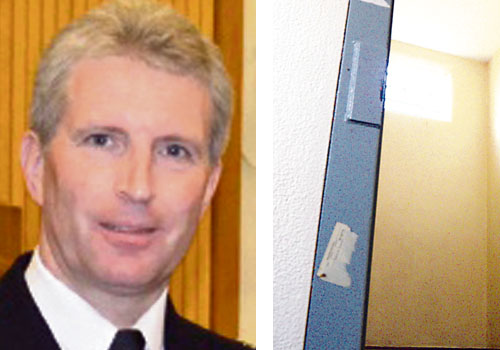
Above: Items stored outside lower-floor cells of the 1913 Grade II-listed Hampstead police station, and the building’s old-fashioned electrics
Published: 30 May, 2013
by ALICE HUTTON
PARTS of Hampstead police station exist in a timewarp of the 1990s.
Just yards from members of the public passing by in Rosslyn Hill, the wormhole is filled with VHS videos, audio cassette tapes, typewriters, chalkboards and piles of hand-written paperwork filed just before the fall of the Berlin Wall – and the invention of the internet.
Rooms look discarded, as if officers were forced to beat a swift, really untidy retreat and simply walked away in the middle of a shift leaving behind stacks of broken furniture, peeling paint, dead technology and dust as they withdrew to more habitable lower floors and never returned.
There is an open bottle of dark liquid on a sink with some crusting mugs that had an expiry date of 1995.
Envy not the person whose job it will be to clean this 19,000 sq ft building. But clean it they will, and soon.
The last police officers to be stationed at the 1913 Grade II-listed pile will leave by June 24 after the long-awaited axe finally fell in March.
When an alternative is found for its front counter, it will be put up for sale as part of the Met’s bid to find £500million savings.
Anyone familiar with the decade-long campaign to save the Victorian behemoth from closure will have some grasp of the history behind it.
The usual stories: how it used to function as a sub-division of the Met with hundreds of police officers, its own magistrates’ court, doctor’s surgery and canteen.
How one of its many cells is named after Ruth Ellis, the last woman to be hanged in the UK after she was taken there for shooting dead her lover David Blakely outside The Magdala pub in South Hill Park in Hampstead in 1955.
Rumours about Oscar Wilde being another former prisoner stubbornly persist despite the fact it was built nearly 15 years after he died.
Sergeant Peter Ryan, who worked there between 1996 and 2000, told the New Journal – following a last behind-the-scenes tour before it closes – of a strange self-contained microcosm in which magistrates threw barbecues with residents on Sundays, and drank with local journalists, and how police officers received Christmas cards and thank-you letters from world-famous footballers in the same month as thwarting IRA terror cells.
“The officers who used to work at Hampstead were called ‘jellies’ because other officers thought it was quiet and parochial and ‘nice’,” said Sergeant Ryan, who now heads up Kentish Town and Cantelowes wards.
“Hampstead has this reputation of being quiet and leafy and ‘nothing much happens there’. You may have had to look harder for the work in Hampstead but it was there.
“In 1999, I think, there were eight or nine domestic violence-related murders.
"In 2004 we went through a spate of these horrific homophobic attacks on gay cruisers on the Heath.
"The last IRA terror cell was in Parkhill Road around 1998. The terrorists put down bombs, or tried to put them down, in rucksacks at bus stops and got arrested outside UCL in Gower Street. And we found their terror cell in ‘leafy’ Hampstead of all places. So it’s London – you go anywhere and you get serious criminals.”
He added: “The thing that made it different was the people and the interesting policing challenge they pose. Because, by default of the property prices, just about everybody who lives in Hampstead is successful in their field.
You go door-knocking and it opens and it’s John le Carré or something. Or Lord Longford.
"They can’t be hoodwinked or given a PR spiel. They are perceptive and you had to try to match them.”
But it went both ways.
“The residents had great affection for their police officers, too, and it always amazed me, like they knew what an unusual situation they had,” he said.
“It was celeb-tastic in certain ways. Jurgen Klinsmann used to send a Christmas card and personal letter to the beat officer he befriended when he was Tottenham’s star striker.
“John Conteh, he was the world lightweight boxing champion, got the coppers to chase him up Primrose Hill with their truncheons when he was training.”
Sgt Ryan added: “Thinking about Hampstead, it’s like a traditional Routemaster bus of police stations – nice to look at but the modern ones are much nicer to be inside of. Full of nostalgia but you wouldn’t want to work in one every day.”
