All the wage: Joern Janssen at 91
The political writer and avant garde architect takes Michael Church through the events of his lifetime that have coloured his views
Thursday, 5th November — By Michael Church
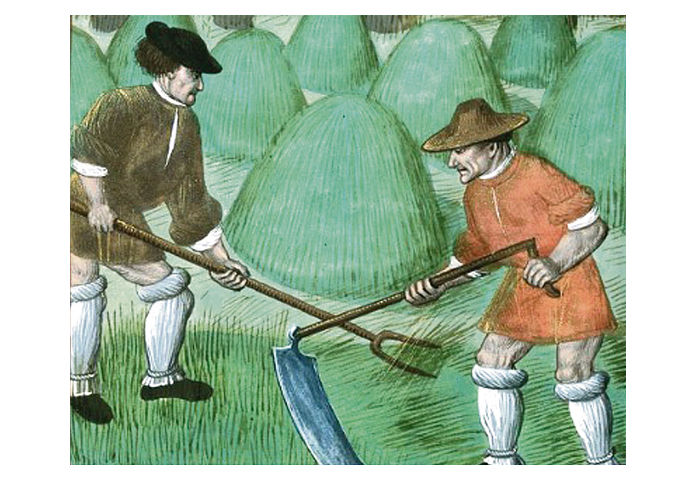
Illustration from the cover of ‘The Transformation of Wage Labour under Statutory Regulation in England, 1349-1563’
I FIRST encountered Joern Janssen as a benign patriarch shepherding his multi-generational family – some of them German-speaking – to the Cally Pool one Sunday morning. It gradually emerged that he was both a visionary architect and a provocative political writer. And we became friends.
Next month sees the publication of his long-awaited study of the history of wage labour in England from 1349 to 1563 in England – a topic much more interesting and important than perhaps it sounds.
And to mark this event Joern, 91, agreed to tell me his life story. So, through some heavily abbreviated snapshot memories, here it is.
Brought up in a suburb of the Rhineland city of Düsseldorf, Joern vividly recalls the pre-Christmas annual St Martin’s march when he was three, and found himself treading over piles of broken glass: that was the residue of the anti-Jewish demonstrations of Kristallnacht in 1938 which had just erupted.
Equally vivid is his memory of being told to greet “Heil Hitler” at school every morning, and to raise his arm in salute to the picture of the Führer on the classroom wall.
“I didn’t like that,’ says Joern, “so I didn’t salute.”
Evacuated to stay with relatives in the countryside to avoid the bombs when war broke out, his war experience was relatively undramatic; his memories of the peace began with American tanks coming down the main street and showering him and his friends with bananas and chocolate.
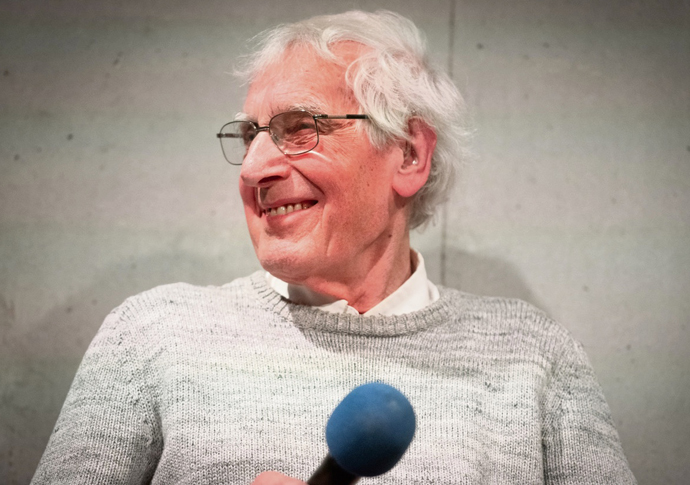
Joern Janssen
As a teenager in secondary school he was swept along in the general atmosphere of post-war liberation.
Then he went to Munich to study architecture, “partly because I wanted to get away from my parents”, even though they’d not been Nazis.
He was a talented mathematician and draughtsman. But what really excited him was the scope which architecture offered to the imagination, particularly when fired up by the avant garde ideas which he and his friends now lived by.
Until this point Joern hadn’t been touched by politics, but encountering the composers John Cage, Pierre Boulez and Karlheinz Stockhausen marked his awakening, and got him writing avant-garde essays and designing impossible but inspirational buildings.
His most notable early product was a city in the sky where cars were excluded: “It was exotic and eccentric,” he says, “but I was putting forward something new and important.”
In the 60s Joern became part of the Fluxus movement, a network that sought to break down the barriers between art and everyday life by blending visual art, experimental music and performance; in Tate Modern there is a group photo of the Fluxus leaders with Joern in the forefront.
Until this point he had no political affiliation, but suddenly in 1971 he joined the Communist Party; just as suddenly he left it three months later. Why?
“I had wanted to do something politically, but I left it because I disagreed with Germany’s close relationship with the Soviet Union.”
He recounts all this in an amused and far-away tone, as he does his uneasy encounters as an idealistic architect facing clients with a corrupt agenda. He finally lost patience with private clients when a very rich one demanded a bathroom clad in solid gold tiles.
“I told her I didn’t do such things,” he says.
With public clients the corruption was more insidious. Having won a European Commission contract to design and build a women’s health and language school in the Central African state of Burkina Faso, he was determined to build it with local materials and local labour, which he did, but since he didn’t employ a French workforce he didn’t get another contract.
Time and again his principles tripped him up, most glaringly in Switzerland. “I had been a professor of architecture in Berlin, but they wanted to get rid of me, so I was given a new contract to teach architecture in the Technical University of Zurich.
“I involved students in research on the work of one of the most important Swiss developers.”
Indeed: Joern and his students uncovered a network of dodgy dealings, and published their findings.
“I was told my work was politically unacceptable in Switzerland,” he says. “It was the university which got me in, and the same university then told me to leave.”
The developer even went to the length of placing full-page advertisements in all Swiss papers, claiming that Joern was a Moscow spy, and should leave the country. He was legally expelled from Switzerland and went back to Germany to teach construction economics, and launched a major research investigation into the humanisation of labour conditions in the German construction industry.
Meanwhile, he got a surprise invitation to speak on the production of the built environment at an international summer school of the Bartlett School of Architecture and Planning in London.
This had been co-organised by a researcher named Linda Clarke, who had been told by a fan of Joern at Geneva University that he would bring some much-needed grit to their proceedings.
And like Julius Caesar after winning a battle, Joern came, saw and conquered – because he and Linda found that they had been researching along exactly the same lines for years. She is now emeritus professor at the University of Westminster. First they worked together, then they set up house together in Islington, then they began the marriage which is now in its 45th happily harmonious year.
The idea for his book – entitled The Transformation of Wage Labour under Statutory Regulation in England, 1349-1563 (Brill Publishing) – dates from Joern’s mid-life realisation that after the Black Death, wage labour, and the social relationships based on it, became central to societies in Europe and stayed that way until the 20th century.
He spent thousands of hours researching in libraries and archives; nobody else has written about how the English system of wage relations developed, and how it spread to other European countries.
Joern has written many books and pamphlets, but this one is his magnum opus, and it’s typical that he’s publishing it through the “open access” system, whereby anyone can browse through it free of charge. Its primary readership will of course be academic, but you never can tell when an innocuous-seeming idea is going to get picked up, dusted down, and show the strength to move mountains.
