The night John Hurt let me sleep on his sofa
Gerry Harrison recalls his old drinking pal, the late Sir John Hurt
Friday, 7th July 2017 — By Gerry Harrison
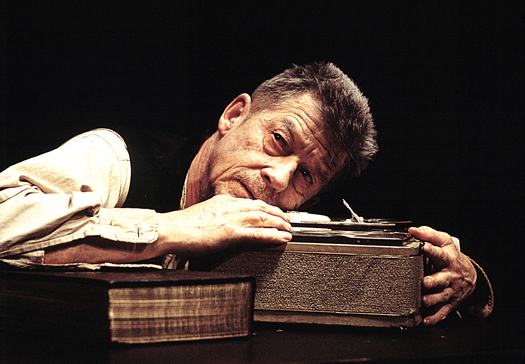
John Hurt in Krapp’s Last Tape
Many careers ago, I slept on John Hurt’s sofa. This was in Hamilton Gardens, near Mornington Crescent. I was an actor and had returned from an arduous 17-week tour of Chips with Everything, but there was nowhere in London I could call home.
From drama school I knew a young actress called Annette Robertson, and had heard that she and John had married. Annette had kindly offered me the sofa in their tiny furnished flat. This was towards the end of 1962.
Our encounters – I would not call them meetings, they were never arranged – took place over the next 50 years and my memories of most of them are now somewhat hazy. We saw each other at parties: I remember one at Lionel Blair’s flat in Notting Hill Gate; another in Ibiza; and occasionally at pubs and drinking clubs.
here was one in Shaftesbury Avenue called Gerry’s, favoured by actors and called the “Den of Equity.”
John was rapidly building a distinguished career of distinguished parts in distinguished productions. Who can forget The Naked Civil Servant or The Elephant Man, for which his craggy features were hidden under hours of makeup? His Wikipedia CV runs to many pages. Some of this work, he admitted, was in “crap productions”, but within them he usually shone.
In the 1970s he lived in Flask Walk, almost opposite the famous pub where he spent a lot of time with Ronnie Fraser and others. Here I met his girlfriend, Marie-Lise, a vivacious Frenchwoman, but I also remember the aftermath of her death. Distraught, John would drown his grief in the pub. He later spoke of a happier occasion: the actor Jon Finch had collapsed on the set of Alien because of an undeclared diabetes problem. As soon as he was removed by ambulance, the director, Ridley Scott, contacted John, who replaced him immediately. John said that from the moment when the alien creature erupted from his chest he believed his career was made.
It was to his house in Flask Walk I brought a rather poor script called East of Elephant Rock. Acting having given me up, I was by then a co-producer, and somehow thought that with two bottles of excellent white wine and the temptation of a trip to Sri Lanka, I could persuade John to play the leading role. We heard the next day that he’d accepted the part.
The film had a tight budget, and at the time I recall there were UK exchange control problems. I had to go on ahead, before the unit and the actors. This was before we could transfer substantial funds, so I had to take off from Heathrow with £38,000 in cash smuggled inside a sock. Fortunately, no one detected my obvious limp.
Because I could not pay everyone their daily allowances immediately, we improvised. I remember that John soon found a source of illegal “arak”, a common moonshine distilled in the Middle East.
One day I heard from John’s agent that his father had died. So that John could make it to the funeral I rescheduled the next two or three days and reserved flights. When I caught up with him he dismissed my careful planning instantly: he had no wish to attend his father’s funeral. I could not understand the reason for this until I learned of John’s unhappy childhood some years later.
He remembered me from Sri Lanka when I saw him next, at a screening of Irish films at the Tricycle in Kilburn. Now living in Ireland, John’s face looked more haggard than ever: it was beginning to accumulate the crumpled, lined features of WH Auden.
His voice had adopted the gruff tones there were heard in the HIV-Aids prevention advertisement. He also appeared to have lost a couple of stone in weight. In fact he told me that he was “off the sauce”. I later heard that he had suffered from pancreatic cancer.
I will always regret that I did not see all of John’s brilliant performances on stage, television or film. However I was delighted to have cajoled the Gaiety Theatre in Dublin to spare me a seat for Krapp’s Last Tape by Samuel Beckett. It was a riveting display of the craft of acting, with all the intensity that this reminiscence of Beckett deserves. After the show we had our last conversation.
Until I read of his death, I did not know that he had been knighted. Never was there a more unassuming recipient.
• Gerry Harrison, a former actor and producer, was a Camden Labour councillor
